
Arsider is not a conventional musical experience. Exposure is recommended only for those prepared for extreme auditory environments, perceptual challenge, and cognitive acceleration.
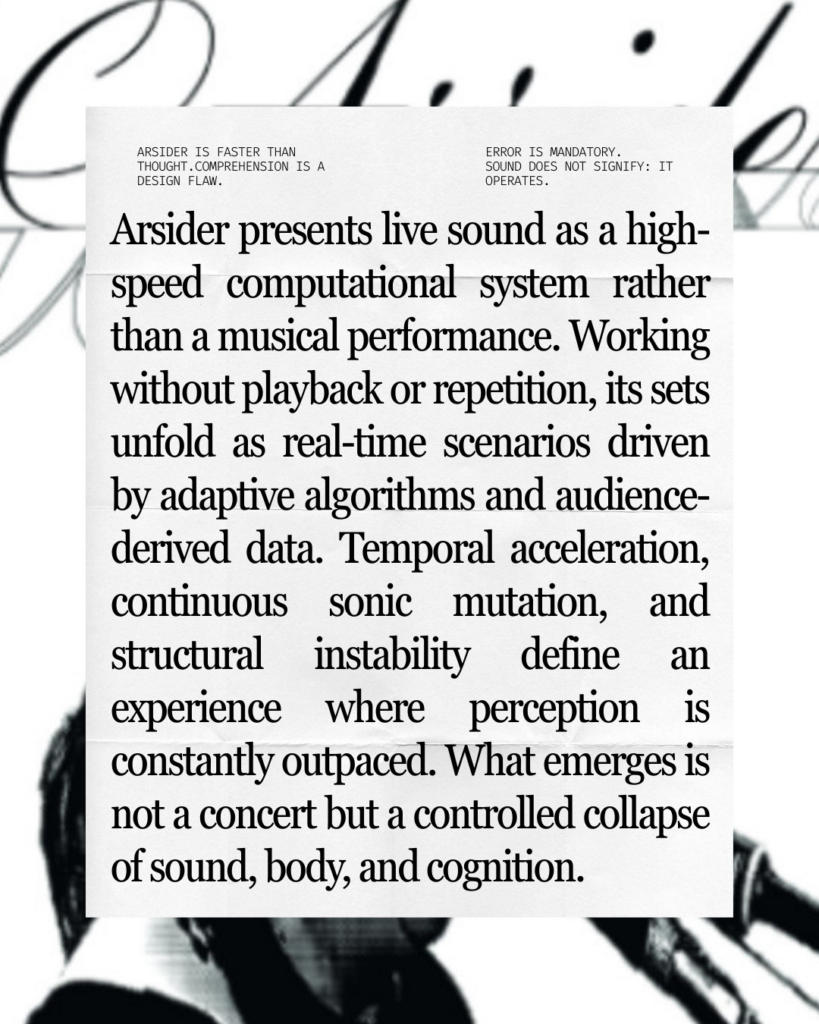
Arsider operates within a framework of accelerationist sound practice, redefining performance as a real-time computational system. By exceeding perceptual synchronization thresholds and denying stable repetition, the project destabilizes predictive listening models and mnemonic consolidation. Sampling functions as an adaptive process rather than referential citation, while error is embedded as a structural condition. The listener is repositioned as a node within an unstable feedback network, raising questions about agency, embodiment, and cognition in algorithmically driven sonic environments.

Repetition is algorithmically denied. Apparent loops undergo continuous micro-variation, disabling pattern recognition and destabilizing memory formation. Sampling is treated as a volatile process rather than archival quotation; sonic materials are decomposed as they are deployed, refusing fixity or reference.


Altro da ARSIDER